

A to-do list app will let you add a forty-first task without protest. A piece of paper runs out of lines somewhere around the tenth task, and then you have to make a decision.
If your best, most productive days ran off a sticky note or the back of an envelope, there’s a reason for that. It isn’t nostalgia. A paper to-do list does something an app is built never to do: it ends.
That sounds like a drawback. It’s not. For having a productive day, it’s a feature.
Why does your to-do list keep getting longer?
Because it was built to. A task app’s first job is never to lose anything. Unfinished tasks roll forward to today, recurring ones come back on schedule, and the list scrolls for a long, long time. Nothing disappears unless you delete it.
For storage, that’s exactly right. You want the dentist reminder to survive a chaotic week.
For deciding what to do today, it’s actively unhelpful. When the list can hold everything, today’s list defaults to everything.
Then there’s the overdue count, the small red number that hands down a daily verdict on a plan nobody agreed to. Plenty of people stop looking at it eventually, which is sensible. It also means the list has stopped being a plan and become a running tally of what hasn’t happened.
None of this is a discipline problem. A tool built for storage is doing its job well, but what sits in front of you now is a different problem.
Why does a paper to-do list work better than an app?
A paper to-do list is a finite list, and its limits do some of the prioritizing for you.
Copying a task is deciding it again
On paper, nothing carries forward by itself. A task you didn’t finish has to be written out again tomorrow, by hand, and that small cost works as a filter. Writing “call about the insurance thing” for the fourth day running is irritating enough to raise the real question: is this going to happen, does it belong on a different day, or was it ever going to get done at all?
Some tasks survive the rewrite. Others drop off quietly, and nobody misses them.
Most software works to remove that kind of friction. On a daily list, the friction is what helps you decide.
Paper planner vs. digital planner: what each one is good at
Apps are better at anything that you have to find later. Paper is better at deciding what you’ll actually do today.
That split covers most of it. A reminder that buzzes at 3pm, a bill that recurs every month, an appointment with a time attached: all of that belongs on a phone. So would anything you might need to search for six months from now.
| Job | Better tool |
|---|---|
| Reminders, appointments and recurring tasks | App or digital calendar |
| Lists shared with other people | App |
| Finding something from months ago | App |
| Deciding what today actually holds | Paper |
| Seeing the whole day or month at a glance | Paper |
| Letting tasks that stopped mattering drop off | Paper |
If this doesn’t match your experience, that’s okay. Some people run their days well entirely on an app, and if that’s you, nothing here is an argument for switching. This is about the days that went better on the back of an envelope, why they did, and why you might consider switching.
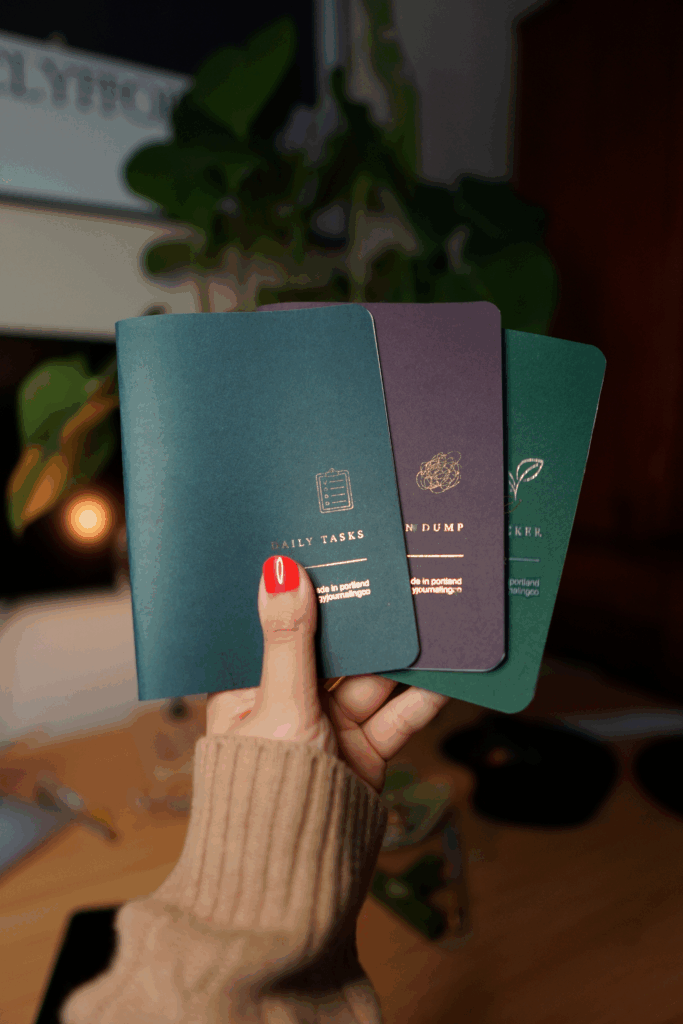
Strategy Journaling Co makes small paper journals built around these limits: the Brain Dump Journal, the Daily Tasks Journal and the Habit Tracker Journal, each A6, 32 pages and made by hand in Portland, Oregon. But any piece of paper will do what these journals do. They limit what’s on the page so you don’t have to do it yourself.


